
MAKING MARIE ANTOINETTE (Telluride FF 2026) – Review by Diane Carson
Eleanor Coppola’s Making Marie Antoinette intimately documents film production
Already celebrated for her dazzling, incisive Hearts of Darkness: A Filmmaker’s Apocalypse (1991) documenting the filmmaking trials of husband Francis Ford Coppola’s Apocalypse Now, Eleanor Coppola’s Making Marie Antoinette (2026) confirms and enhances her reputation as an accomplished filmmaker in her own right. Early in the documentary, in excerpts from her journal spoken by Diane Lane, Eleanor acknowledges that she much prefers to stand back and observe, that “it is against my personality to shoot a documentary, and yet I continue to do so.” And so Eleanor picks up her camera in March 2005 to capture 80 hours of behind-the-scenes footage of her daughter Sofia’s third feature, Marie Antoinette (2006). Now, on the occasion of Marie Antoinette’s twenty-year anniversary, Eleanor’s fine eye for revealing the cinematic world is again on display in Making Marie Antoinette.
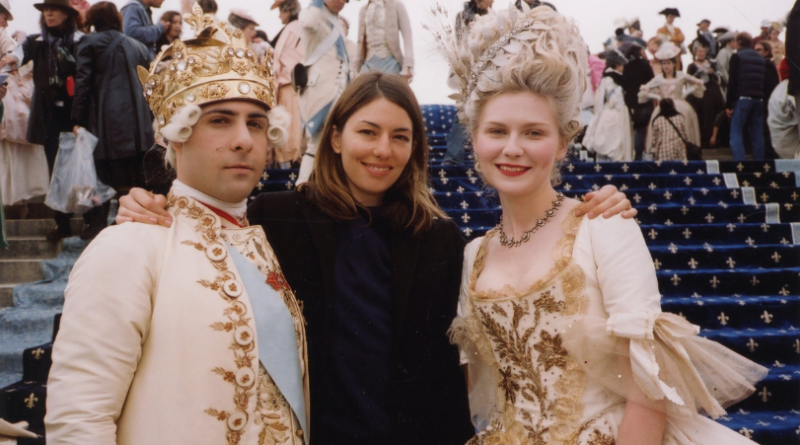
Over a 57 day shoot, as only an insider can, Eleanor bobs and weaves in and out of the preparations for shooting multiple scenes. Thoroughly knowledgeable about the multifarious production essentials, Eleanor provides rare and informative moments for the thousands of decisions that Sofia must make and the extensive minutiae that matter in a film. For example, she eavesdrops on the highly admired costume designer Milena Cannonero who bore responsibility for 72 dresses for Kirsten Dunst (Marie Antoinette) alone, plus costumes for scores of supporting players and extras. She scrutinizes the dozens of wigs that required washing, drying, and restyling every day. Through extraordinary access, Eleanor details the intricate color coordination of wallpaper, flowers (real versus the usual imitations), curtains, drapes, and even shoes. There’s lighting, weather, Sofia’s illness, and a visit to the set by Francis Ford, Sofia’s father. Music must be selected, here a combination of period music with new romantic selections complementing what Sofia’s describes as “my own hip approach to history.”
Scenes capture the stress that comes with a $40 million budget. Valuable assistance comes from Sofia’s trusted brother Roman serving as second unit director. In a candid conversation with Eleanor, Roman adds that Sofia contradicts the stereotypical idea of a director as aggressive, controlling, and egocentric. He sees Sofia as poetic and reserved, an apt description on full display throughout the documentary. Always humble and affable, Sofia expresses her awareness of the undertaking as a director as young as she, saying she feels “almost embarrassed for her extravagant undertaking,” and yet she enthusiastically embraces the challenge. Admitting she didn’t know how bold her request was, nevertheless, for the first time ever, the French government allowed a film production to shoot at the actual Palace of Versailles and its gardens on their closed Mondays, the opulence informing and intensifying every scene. Other days required moving to and establishing locations at nearby chateaux as Sofia struggles to stay on schedule, which she does to her great relief and surprise.
Through it all Eleanor straightforwardly particularizes the demands, challenges, and rewards for all involved. She records Jason Schwartzman (Louis XVI), Steve Coogan (Count of Mercy-Argenteau), Molly Shannon (Madame Victoire), and others in casual moments during hours of waiting, waiting, and waiting. Sofia confers with cinematographer Lance Acord, wonders what holds up the extras needed for the walk through Versailles’ Hall of Mirrors, and shows the sheer exhaustion of shooting for numerous long days.
At the Telluride Film Festival premier screening, Sofia introduced the documentary explaining that during the pandemic she and Eleanor decided to tackle the 80 hours of footage. After Eleanor died in 2024, Sofia completed the editing, a heartfelt tribute to her mother. Praised by Francis Ford Coppola as “one of the best handheld camera operators ever” and by Sofia as “famous in our family for having the steadiest camerawork,” Eleanor proves her mettle time and time again through expert compositions and beautiful images, all captured as she roams the back rooms and private spaces. Also of interest, in the film’s narration, Eleanor comments that she always had her own creative drive, a talent deferred for family. Remarkably and courageously, at 80, she made her own first narrative feature, Paris Can Wait (2016). For Making Marie Antoinette, she will be remembered and praised for an intimate, honest look at the hard, exhausting work film viewers seldom have the opportunity to watch and, through Eleanor’s unparalleled access, savor. As further testimony to its value, Making Marie Antoinette is included in the 2026 New York Film Festival offerings.
