
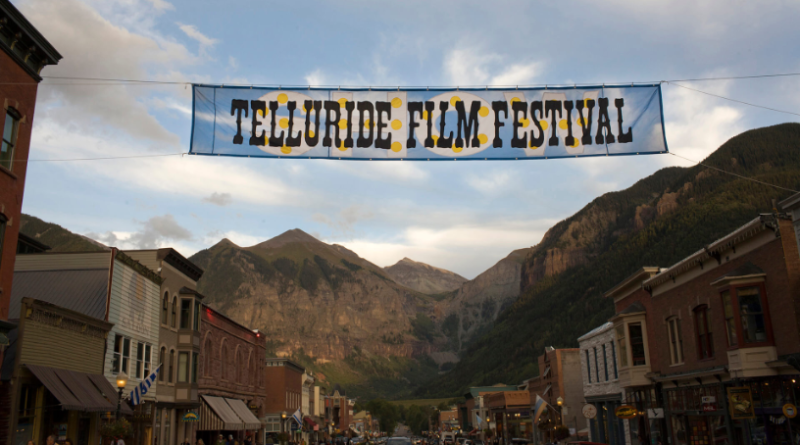
Telluride Film Festival 2026 Overview (Part One) – Diane Carson reports
Familiar issues of cultural and national politics with the accompanying struggle for personal freedom and identity dominated the outstanding films showcased at the 53rd Telluride Film Festival, always held Labor Day weekend in Telluride, Colorado. Nonfiction and fiction, American and international, historical and contemporary—all the selections offered strong presentations of themes and concerns relevant to the current ideological environment.
Most impressive, one documentary and one fictional work based on actual events present staggering historical stories. First, Pegah Ahangarani’s Rehearsals for a Revolution offers her autobiographical memories of Iran’s past forty years of violently crushed demonstrations. In an experimental style, Ahangarani immerses viewers in with the marching protestors brutally and suddenly attacked by police and military. Divided into five chapters drawing on relatives’ and mentors’ experiences, the documentary explores individual and collective opposition from 1979 to 2026. Through one uprising after another, oppressive Iranian regimes suppress any resistance to their dictates. An actress earlier in her life, Ahangarani benefits from her architect father’s love of cinema, integrating some of his 8mm and 16mm film into her documentary along with her own images, newspaper items, and oral testimony. In her footage, she often races with her camera as it chaotically focuses on soldiers’ massacring hundreds to thousands. Dropping her camera one time in a frenzied melee, a fellow demonstrator grabs and returns it to her.
In an interview for Telluride, Ahangarani notes, “The act of remembering is a kind of resistance, especially in a country like Iran.” Sadly, in a current illustration of political repression, Pegah Ahangarani, who now lives outside Iran, was not allowed to board her flight to Telluride because of travel issues. Details were not available. Nevertheless, Ahangarani’s fight for Iranian freedom continues. At this year’s Cannes Film Festival, Rehearsals for a Revolution won the L’Œil d’or (Golden Eye) documentary award.
In a quite different, narrative genre, director Jennifer Peedom’s Tenzing mounts an equally searing story of British political machinations that did wonderfully result in triumph for Tenzing Norgay. Tenzing is applauded now as the Nepalese-Indian Sherpa that summited Mount Everest/Chomolungma alongside Edmund Hillary on May 29, 1953, the first individuals to summit the 29,028 foot mountain. Tenzing’s personal and political challenges inform Peedom’s film. At a Telluride Film Festival panel interrogating the idea of heroes, Peedom said, “I’m trying to change the lens on heroism.” She succeeds, defining Tenzing’s involvement as a spiritual journey. Questioning whether Chomolungma/Goddess Mother of the World (the Tibetan name for Everest) should be climbed, the Buddhist Tenzing (Genden Phuntsok) forges a bond with New Zealand born Edmund Hillary (Tom Hiddleston), both recipients of prejudice on the British expedition zealously intent on being the first to summit Everest.
In fact, Tenzing faced prejudice within the Tibetan community during his early life because he was born “on the other side of the mountain,” that is, Nepal and, therefore, not a Tibetan Sherpa by birth. He couldn’t read or write, settled at 19 in Darjeeling, India (the staging area for mountaineering), had to relentlessly pursue and talk his way into the climbing expedition, and was often dismissed as the expert he was by the British leader John Hunt (Willem Dafoe). Tenzing’s heroism is a quiet kind, a spiritual courage, a striking representative of Peedom’s advocacy for a different kind of hero. As she noted, for westerners, they want to conquer the mountain. For Tenzing, the spiritual journey is paramount, one does not disrespect nature. She also remarked that though this is primarily focused on the men involved, the women play a critical (and often unacknowledged) role in the event.
Another of the visually impressive works, Austrian director Markus Schleinzer’s Rose follows the title character, a soldier who returns from war in 17th-century Germany. With all the required official documents, Rose claims an abandoned farm. Hard working, proving himself in the community, what the local population doesn’t know is that ‘he’ is a woman. Soon a neighbor with five daughters forces one upon Rose, with increasing difficulties to follow. Beautiful black and white compositions deliver an environment shattered by the violent confrontations that follow. The harmony and neighborly support prove razor thin in a community where individuals either conform to expectations or find their lives in danger, especially when gender identity is involved.
As Rose, Sandra Hüller gives another of her bravura performances. One of the three Silver Medallion tributes that the Telluride Festival includes each year, Hüller also stars in Polish director Pawel Pawlikowski’s Fatherland. Set in 1949 Germany, Erika Mann (Hüller) travels with her famous father Thomas Mann (Hanns Zischler) from Frankfurt to Weimer. Thomas will receive the prestigious Gothe Prize for his literary work in Frankfort with a second Goethe Prize awaiting his acceptance in Weimer. Conflicting East and West German identity gives Mann the opportunity to assert that “art does not recognize borders.” Strong critiques of Fascist ideology pull the past into the present. In both films, Sandra Hüller’s embodiment of radically different characters showcases her superb acting ability.
Two films poignantly dealt with the issue of AIDS. In Elsinore, Ian Charleson (Andrew Scott) fears and then courageously grapples with his diagnosis. Based on actual events, Charleson gained notoriety playing Eric Liddell in Chariots of Fire (1981), but quite desperately wants to return to the stage. Upon being cast in the London National Theatre’s Hamlet, he learns of his medical condition, one fraught with misunderstanding and prejudice in 1989. Some friends support him, others urge him to go public with his AIDS diagnosis, friendships collapse while others mature. Reactions by Charleson, his fellow actors, doctors, and others with AIDS provide a reminder of the trials of the gay population and those who supported them.
Also set in the 1980s, director Ira Sachs’ The Man I Love finds another thespian battling AIDS with all its challenges. Drawing on his experiences in New York at that time, Sachs anchors the exploration in Jimmy George (a splendid Rami Malek) who insists on adapting an obscure film to the stage. Jimmy’s partner Dennis (Tom Sturridge) and sister Brenda (Rebecca Hall) shower Jimmy with love but also fear Jimmy shortening his days with exhausting indulgence in his theater project. Friends and acquaintances introduce a range of reactions as the 1980s New York gay scene achieves a vibrant but somewhat fearful quality.
Yet another sympathetically defined group of individuals grace British director Mike Leigh’s Tender Loving Care. Through Leigh’s three-dimensional, endearing characters, an extended family comes into sharp focus. Friends Amy (Kate O’Flynn) and Rosie (Alice Bailey Johnson) are social workers facing daunting challenges from those they aim to help and an often unsupportive bureaucratic system. Thoroughly involved in Amy’s and Rosie’s day-to-day activities, Amy’s parents increasingly encounter crises that come with aging. As always with Mike Leigh, his empathetic but never melodramatic approach gives Tender Loving Care a rare, honest appeal.
Finally, for a dose of welcome humor, director Jesse Eisenberg’s The Debut brings a clueless but aspiring actress to vibrant life. Middle-aged New Jersey homemaker Mona Friedman (Julianne Moore) decides to try out for a theater production of the musical Nosy Neighbors. It becomes director Jerry’s task to somehow metamorphosize this impossibly awful singer and actor into a passable member of the musical. As the exasperated director Jerry, Paul Giamatti brings the house down with exquisite nonverbal reactions peppered into hilarious comments.
Full reviews of these and other films at the Telluride Film Festival will follow in Telluride Film Festival 2026 Overview (Part Two). The heartening news is that there are many good films opening this fall.
