
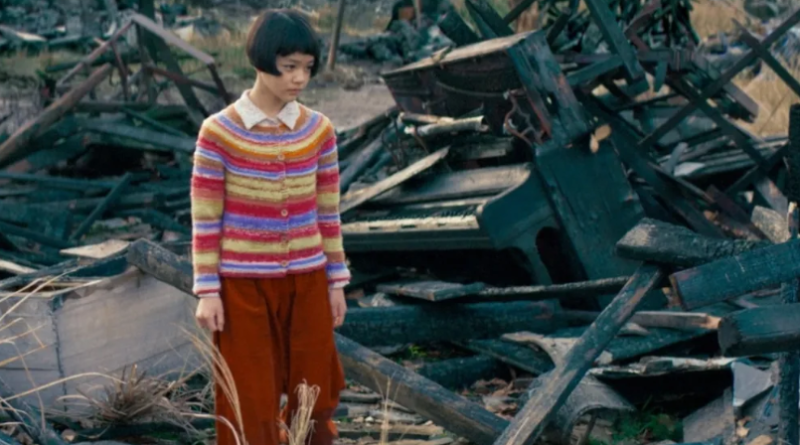
CHILDREN UNTOLD (TIFF 2026) – Review by Beth Accomando
There is no shortage of war films about soldiers fighting on the battlefield (take your pick from All Quiet on the Western Front to Thin Red Line to 1917) or politicians debating strategy (Churchill, Pressure) or families struggling under siege (Hope and Glory, Blitz). But films that focus on the aftermath of war, especially from the perspective of the losing side, are not as common. Italian neo-realist cinema probably offers the best example of filmmakers who rigorously and stunningly explored postwar life, recovery and reconstruction in films such as Rome: Open City, Bicycle Thieves, and Shoeshine.
Filmmaker and author Miwa Nishikawa chooses to focus her attention on postwar Japan and a 12-year-old orphan trying to survive in Children Untold, based on her unpublished book. The film had its world premiere at TIFF earlier this month.
U.S. audiences should be familiar with the fact that the U.S. dropped atomic bombs on Hiroshima and Nagasaki because that’s what has been taught in our schools. And the context has always been that the decision to use the atomic weapons helped bring an end to the war. But what Americans may be less familiar with is the firebombing of Tokyo in March of 1945, months before the atomic bombs were dropped. The U.S. air force sent hundreds of planes loaded with 1700 tons of incendiary explosives that were dropped across Tokyo, setting off a firestorm that destroyed nearly 16 square miles of the city, killing up to 100,000 people, and leaving a million homeless and displaced.
It is into the devastated ruins of Tokyo, that Nishikawa sets the bulk of her story, looking at a generation of children, many orphans, who had to deal with the consequences of the firebombing and the aftermath of living in a country that had been forced to surrender. The political backdrop of the film involves Japan dismantling its military, the imposition of a new constitution, and a period of occupation by Allied forces. This is a part of history that we are not taught or exposed to in the U.S. But Nishikawa opens our eyes to another side of history, and there is much that is heartbreaking and tragic.
When we first meet Kotoko (Ami Koyae) she is impressing us and her friend with her skills playing classical piano. But she is sternly punished by her teacher for playing the music of Japan’s enemies. Kotoko is the daughter of musicians and after leaving her school and returning to Tokyo, she must face the loss of her parents and her brother. With no family and nowhere to go, she is forced to live on the streets and quickly realizes that it is safer to disguise herself as a boy to survive. This allows her to join a group of orphaned boys working for a local yakuza clan. But when a job goes awry, they land in a brutal island facility for orphan boys. The war may be over but Kotoko is still battling to survive.
Nishikawa’s film feels relentless in the horrific conditions it depicts. Kotoko faces tragedy, hardship and bad luck at every turn. The only relief from grief and loss comes from brief interludes of music and the friendship she forms with the orphan boys. There is a parallel story involving her teacher, an unwed mother, who feels guilt for leaving Kotoko alone upon arriving in Tokyo.
Nishikawa creates an emotionally compelling narrative driven by stellar performances all around but especially from the young Koyae. Koyae is often silent as Kotoko, taking in a world she does not fully comprehend but one that she must quickly adapt to. She resists sentimentality but delivers a richly expressive performance.
But Nishikawa tries to cram so much into this single film that it starts to strain at 150 minutes. In addition to the underworld Kotoko must navigate as an orphan, Nishikawa wants to explore yakuza infighting, repercussions of the new constitution, racial tensions between Koreans and Japanese, corrupt politicians… it’s just a lot in one film.
Nishikawa did research for her yet to be published book that looks at children who lived through the war and what they had to do to survive the aftermath. I think her abundance of knowledge on the subject made her want to share all of it but I think a narrowing of the focus for the film could have improved it.
Godzilla Minus One set its story along a similar timeline and effectively conveyed much of the same history of postwar Japan but in a more streamlined manor as the backdrop to its kaiju horror tale. Although the films are tonally and narratively very different, they make interesting companion pieces in terms of opening western eyes to what Japan was going through in the aftermath of World War II.
What Children Untold does best is convey Kotoko’s perspective. What we see of her life through her eyes is what is most powerful and effective in the film. We see how quickly she must grow up to navigate life on the streets; how resourceful she must become; and how difficult it is for her to hold on to a hopeful part of her humanity. And some of the most effective moments in the film are the simplest, like Kotoko walking down her former street and naming all her neighbors who are now gone and whose homes are rubble. We feel the loss and grief on a very personal level with Kotoko. The scope of the destruction she shows us feels on par with the devastation left after the atom bombs yet it is not a part of the war that is often explored.
Children Untold is deeply compassionate and urges us to look at Kotoko’s story not as something from the past but rather as a reminder of how war and its aftermath continues to impact innocent victims like children today.
