
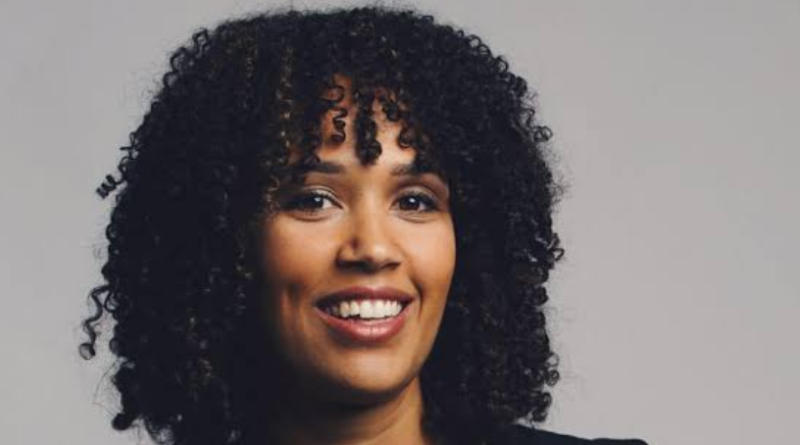
SPOTLIGHT October 2026: Zoey Martinson, Writer, Director, THE FISHERMAN

 Zoey Martinson refuses to believe a story about hardship has to look or sound like hardship. Her feature debut, The Fisherman, is a magical-realist comedy shot in Ghana, with a wisecracking talking fish, a riot of color, and a fishing community facing displacement — and that story gets to be funny, vibrant, and fully human. We loved it at AWFJ enough to select it as our Movie of the Week, and we wanted to spotlight the filmmaker who created it.
A GRIOT’S GRANDDAUGHTER
Martinson was born on the Menominee Nation in Wisconsin, and her first storyteller was her grandmother, a griot. Her father is of African descent. When she became a bit too “spirited” as a teenager, her parents sent her to live in Keta, a small fishing village in Ghana’s Volta region. She spent her afternoons watching fishermen haul in their nets and dreaming about what lay beneath the sea. Keta is where The Fisherman really began, long before she imagined and wrote it into being. She came back to the U.S. for school a very different person.
When we asked Zoey about her grandmother, and about the influences to her filmmaking from her time living in the Volta region in Ghana, she had this to say:
“My grandmother was one of my earliest introductions to storytelling. She could take something ordinary and make it feel larger than life, funny, dramatic, sometimes mythical. I think I learned early that truth and imagination didn’t have to be opposites.
“Living in Keta, in Ghana’s Volta Region, was another turning point for me. It was the first time I felt truly comfortable claiming what I wanted for myself. I lived near the coast, and because I was a strong swimmer, I would occasionally help the fishermen in exchange for fish. I was surrounded by people whose lives were deeply connected to the ocean, and by a culture where humor and storytelling were part of everyday life. That experience stayed with me. The film isn’t autobiographical, but emotionally, its roots are there.”

Before Zoey was a director, she was an aid worker and teacher, serving in refugee camps across West Africa, in South Africa, and at the U.S./Mexico border. That included a Liberian refugee camp in Ghana where she worked with former child soldiers, and all that experience informed her aesthetic as a filmmaker, as well as her passion for meaningful stories.
STREET PERFORMER TO STAGE DIRECTOR
Martinson began as a commedia dell’arte street performer around Europe, then landed in New York, where she co-founded Smoke & Mirrors Collaborative in 2012. Her play Olityelwe (formerly Ndebele Funeral) won Best Play at FringeNYC, ran Off-Broadway, and toured South Africa and the UK. Skype Duet toured Europe and Australia. Fellowships from Lincoln Center, Manhattan Theatre Club, the Dramatists Guild, and the Rauschenberg Foundation’s Artist as Activist program followed. Somewhere in the midst of all that action, she also earned her MFA at NYU’s Tisch School of the Arts.
Zoey’s aesthetic, in her own words:
“My stage work has often been described as magical realism, and I think that naturally found its way into my filmmaking. I’m interested in worlds where the extraordinary can exist right alongside everyday life without anyone needing to explain it. Of course the fish talks.
Visually, I love color and shadow, and I’m very interested in giving comedy a strong cinematic language. Comedy is sometimes treated as though the camera’s only job is to capture the performance and dialogue, but I want the filmmaking itself to participate in the joke. Composition, movement, color, editing and even negative space can all be funny.”
SHORT FILMS, BIG NOTICE
 On screen, Zoey’s shorts got noticed first. La Oposición played SXSW, and Cupids premiered at Tribeca, aired on BET and CBS, and earned an NAACP Image Award nomination. The first short version of The Fisherman won Diversity at Cannes in 2020. She has a lot of experience on the small screen as well, having directed six episodes of A24’s Ziwe, written for HBO Max’s Betty, and directed for MTV/Paramount+ and Hulu. She was also a finalist on Issa Rae’s Project Greenlight.
We asked Zoey what she sees as the five biggest milestones that led her to this moment:
“The first was being a shawl dancer and traveling to powwows when I was young. Before I had the vocabulary for directing, I was learning about movement, rhythm, community and physical storytelling.
“The second came in high school. My theater director told me I wouldn’t be cast unless there was a Black character, and in four years they never chose a play with one. So I started writing and directing my own work. Watching audiences respond taught me that I didn’t have to wait for someone to create a place for me.
“Third was my training and traveling. I studied photography and Ancient Greek theater at Richmond University in London while working with a Commedia dell’Arte street-performance company that toured Europe on weekends. I later trained at SUNY Purchase and NYU Tisch Grad. So photography, physical comedy, classical theater all still live inside my filmmaking.
“Fourth was beginning my professional writing and directing career in South Africa and Ghana. People there saw value in my voice and training and gave me opportunities to direct. Working across cultures fundamentally shaped the filmmaker I became.
“And fifth was the accumulation of the work itself. I made plays off broadway, eight short films, wrote for HBO and directed television for A24 and Hulu before anyone handed me the opportunity to direct a feature. The Fisherman didn’t appear overnight. It’s built on every one of those experiences.”
A TALKING FISH GOES TO VENICE
 The Fisherman started as a short film that Martinson wrote when she learned that Jamestown, home to Accra’s Ga fishermen, was being cleared for a new seaport. She parlayed the short film into a feature, which premiered at Venice International Film Festival in 2024. It was the first Ghanaian film selected for Venice International Film Festival, where it played to a sold-out house, got a standing ovation, and won the UNESCO Fellini Medal. More recognition followed with Best Director at the American Black Film Festival and the Pan African Film Festival’s Ja’net Dubois Best Feature Narrative award.

Zoey Martinson uses magical realism as part of her tool box, and it’s used to great effect in The Fisherman, so we asked her about how she utilizes it, and she had this to say:
“Magical realism is probably just how my brain processes difficult things. I grew up poor, and imagination was one of the ways I coped with circumstances I couldn’t control. You could look at the world exactly as it was, or you could imagine that there was another world sitting right on top of it. That instinct never really left me.
“As an artist, magical realism gives me permission to approach difficult subjects sideways. The Fisherman is dealing with aging, disappearing livelihoods, environmental change, generational divides and the fear that the world no longer has a place for you. Those are heavy ideas. But then a bougie Nigerian fish starts talking to you. Sometimes laughter allows an audience to get much closer to something painful before they realize they’ve let their guard down.”
JOY AS RESISTANCE
 Martinson rejects the cliched idea that African stories must be shot in dusty, desaturated tones, or that an African film has to be grim to be taken seriously. When international consultants urged her to make the script more dramatic, she held to her own vision. She grew up in communities that use humor to get through hard times. “Comedy comes from our deepest tragedies,” Martinson explained in an interview with OkayAfrica. Joy isn’t a distraction from the message, it’s the point. She has been making that case for much of her career, including in 2021, when she spoke about her award-winning short Cupids, and the importance of comedy and joy in Black stories. She learned how to channel truth into comedy by listening to experts. To write the bank scene in The Fisherman, she sat down with a real banker to learn how a fisherman might try to get a business loan, then built the comedy around those facts.
BUILDING HER OWN GATES
Martinson is unsentimental about what it takes for a woman of color to get films made. Zoey has been straightforward in relating that The Fisherman met plenty of rejection and struggled to find distribution. She heard over and over that she needed recognizable celebrities to star in the film, and that no one would watch an African comedy set in Ghana. “They have never let me in, so I have built my own gates,” she told The British Blacklist.
We asked Zoey what the biggest challenges were to getting The Fisherman to the screen were:
“Making the film was fun, but one of the biggest surprises was discovering how hard it was to convince the international industry of the film’s value even after we had made it.
“When we were selected for Venice, we had never launched a feature at a festival of that scale. We were learning in real time. Then, when we began looking for sales representation and distribution, we repeatedly heard some version of: “Africa isn’t a market,” or “Ghana isn’t a country of focus.” There was often an assumption that because the story was specifically Ghanaian, its themes couldn’t also be universal. That was incredibly frustrating because the audiences kept proving otherwise.

“The experience taught me that sometimes the challenge isn’t proving there is an audience. It’s getting an industry accustomed to overlooking that audience to recognize what’s already there.”
Zoey sees herself in Shasha, the young woman in The Fisherman who dreams of captaining a boat, in a region where women aren’t allowed to fish. She told a feminist story through a male lead, bringing more women into the frame, while respecting the traditions of Ghanaian fishing. Interestingly enough, Zoey says as a female director, she faced fewer obstacles working in Ghana’s film industry than she sees in the U.S.
Zoey has thoughts on her continued challenges as a Black female filmmaker, and some advice to younger artists:
 “One of the most frustrating things is that the question of whether I “can do it” seems to keep resetting. I’ve written and directed television. I’ve directed multiple short films. I’ve made a feature that premiered at Venice and went on to win awards. And yet, when I’m considered for certain directing jobs, there can still be this underlying question: Can she do it? At this stage, I wish that wasn’t the question. I would love to be asked whether my artistic sensibility fits the project or whether my point of view excites you. Let me pitch and decide I’m wrong for it! That’s part of the job. I would just love the opportunity to be considered for the work rather than continually having to prove my capability.
“For younger filmmakers, I would say: don’t wait for permission to become the artist you already know you are. Make things. My high school wouldn’t cast me, so I wrote. The traditional industry didn’t immediately open its doors, so I built a career in places that did.”
Her advice for emerging artists: let your curiosity outweigh your fear, stay creative, and keep creating. It seems to be working for her!
WHY WE CHOSE HER
 Martinson goes to the places the Hollywood gatekeepers write off and finds the wit, the warmth, and the beauty that were already there. Then she turns the volume up loud enough for Venice to hear, no small feat for a female filmmaker of color, since they are so often dismissed and their stories sidelined. Zoey has continually built her career on her own storytelling, when no one held the door open. The Fisherman is the proof. The Fisherman opened in limited release in New York at the Quad Cinema on September 18th to rave reviews, and now we can’t wait to see what Zoey Martindale does next. —Leslie Combemale
